
Technical SEO and Google Indexing Issue Fixes
An important page missing from Google needs a diagnosis before it needs a fix. Google may be unable to fetch it, seeing conflicting signals, choosing another URL or deciding not to index it. Some excluded URLs are working exactly as intended.
Khalsa Website Designers investigates technical search problems involving crawl access, noindex directives, canonicals, redirects, sitemaps and WordPress configuration. The work separates a correctable website fault from a search outcome that no developer can guarantee.
Request an indexing issue assessment. Send a few affected URLs, the Search Console status if available and what each page is intended to do. Avoid sending account credentials or an unredacted account export.
If your business serves customers abroad, explain which pages and markets matter when requesting an indexing investigation. A company's location in Punjab does not make a page rank in Canada, Australia or the UK, and a technical fix cannot guarantee Google's indexing decision. To discuss the affected URLs, use the existing WhatsApp icon or the contact form; share Search Console access only through an agreed secure process.
First decide which URLs deserve independent indexing
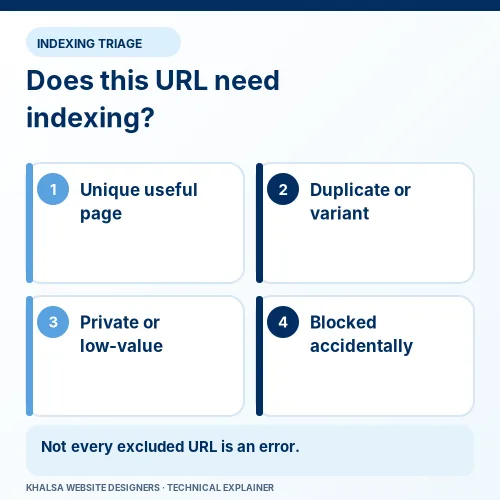
A healthy website does not need every generated URL in Google's index. Filter combinations, internal search results, obsolete URLs and duplicate views can have legitimate reasons to be excluded. Public service pages with distinct useful content usually have a different purpose.
| URL situation | Appropriate investigation |
|---|---|
| A unique business page is unexpectedly absent | Inspect access, response, directives, canonical signals, content and discovery paths. |
| A duplicate points to the intended canonical page | Check that the preferred page is suitable and indexed; do not treat every duplicate exclusion as a fault. |
| A page is intentionally private or noindexed | Verify the restriction matches its purpose. Indexability is not the objective. |
| A removed page has no equivalent replacement | Confirm an appropriate not-found response and update internal references. |
| Many important pages changed after a launch or move | Compare shared templates, redirects, staging controls and configuration before editing URLs individually. |
The objective is to make the right pages accessible, understandable and eligible for search. Turning every report row green is not a useful project brief.
Crawling, indexing and ranking answer different questions
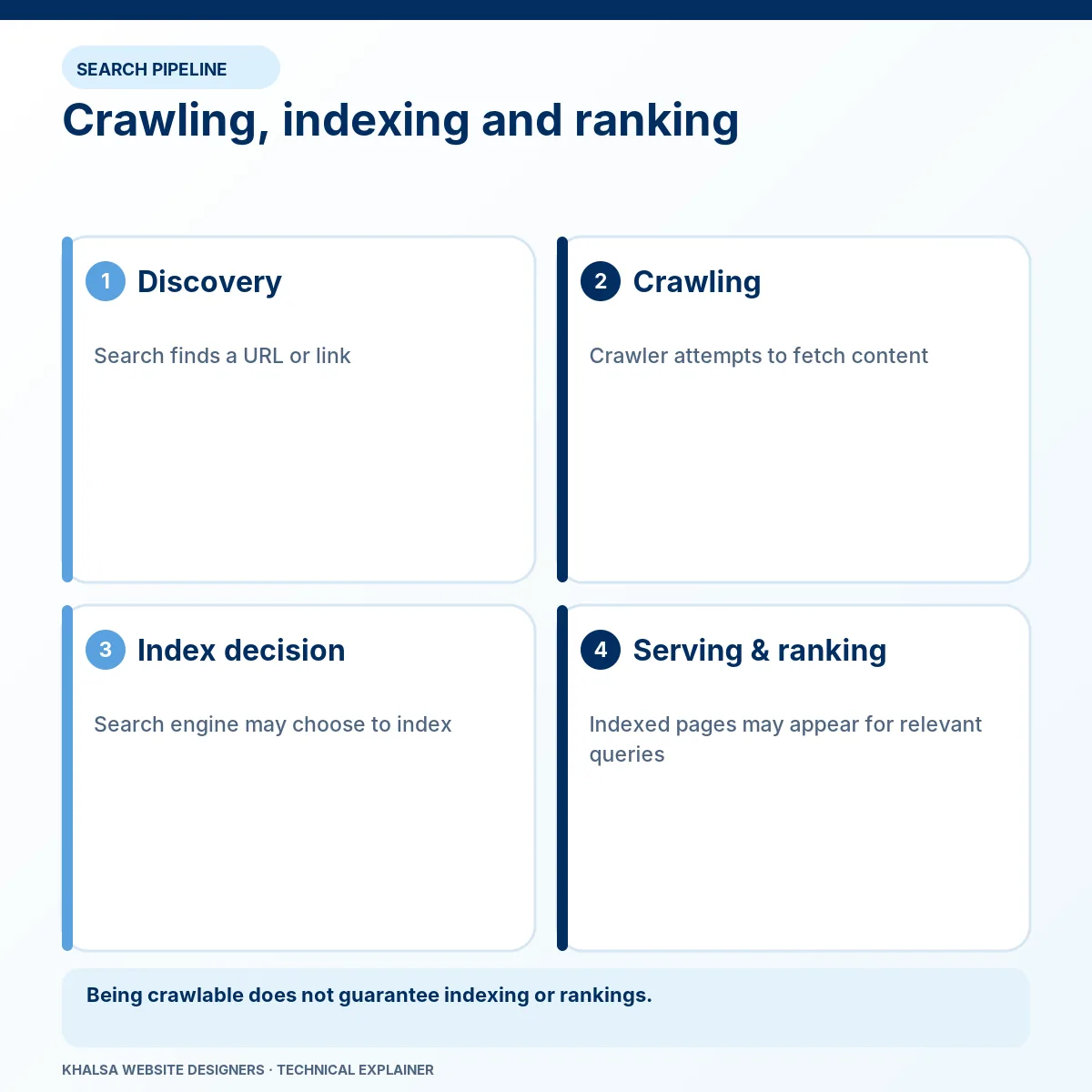
Discovery concerns whether Google knows a URL exists. Crawling concerns fetching its content and resources. Indexing involves processing and selecting content, including a representative URL where duplicates exist. Ranking concerns which eligible results Google selects for a particular search.
Google's technical requirements establish minimum eligibility, including accessible content and a successful response. Meeting those requirements does not guarantee indexing. An indexed page is also not guaranteed a visible position for every target query.
For overseas businesses, a provider's physical location does not create a special indexing mechanism. The page still needs relevance to the visitor's task, accurate service information and normal search eligibility. False foreign addresses and repeated city pages are not a sound substitute.
Inspect the exact URL and the date of the evidence
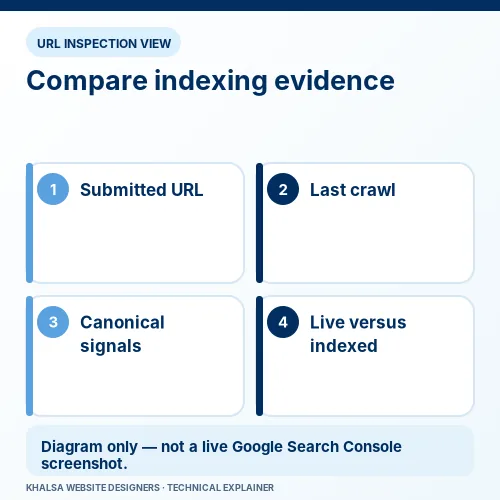
Search Console's indexed record and live test describe different states. The indexed record reports Google's stored information. The live test evaluates what can currently be fetched and some aspects of indexability; it does not establish that the current version is in the index.
The URL Inspection documentation also explains that the live test cannot predict Google's selected canonical. A report that predates a repair must be interpreted against the change log.
An investigation should record the exact URL, property, report time, last crawl where available, response and selected canonical information. Look for patterns across affected templates. One failing product template can explain many URLs; one old URL variant should not trigger a sitewide rewrite.
Correct access and indexing controls deliberately
Robots.txt and noindex serve different purposes
A robots.txt rule controls crawling. A noindex directive tells a supporting search engine not to index content it can fetch. Blocking crawling can prevent Google from seeing a noindex directive; it is not a reliable way to remove a URL from search.
Check both the HTML robots meta tag and any HTTP X-Robots-Tag header. WordPress settings, SEO plugins, server rules and staging deployments can each affect the result. Google's noindex guidance explains the crawl-access requirement.
Never remove all restrictions indiscriminately. Staging, account pages and private resources need protection. The repair should identify the rule affecting the intended public URL and preserve the controls needed elsewhere.
Responses and rendered content need to agree
A page returning HTTP 200 can still contain an error message, empty template or content unavailable to the crawler. A redirect may lead to the wrong destination or loop between hostnames. A user-friendly missing-page screen should not be mistaken for a useful indexable page simply because the server returns success.
Inspect the content Google can access, including resources needed to render the main information. Public browser visibility and search-engine processing are related but require separate evidence where scripts or restrictions intervene.
Make canonical, redirect and sitemap signals coherent
A canonical identifies the preferred representative of duplicate or similar content; Google makes the final selection. It is not an order to index a page, and it is not a substitute for a redirect when a URL has genuinely moved.
The investigation compares declared canonicals, internal links, redirects, sitemap entries and the actual content at the destination. An HTTPS page that declares an obsolete staging URL creates a different problem from two harmless parameter variants pointing to the same useful page.
Google's canonicalization explanation describes how representative URLs are selected. A repair should make the intended relationship clear rather than adding a canonical to every problem without understanding it.
Sitemaps support URL discovery. Include intended canonical, indexable destinations and maintain accurate signals. A sitemap cannot force Google to retain every listed page. If a migration caused the inconsistency, WordPress migration recovery addresses the cutover and application dependencies.
When the problem needs better content, not another setting
A technically eligible page can remain unindexed. Near-duplicate service pages, repetitive location variants or pages offering little beyond a template need an editorial decision. Adding arbitrary words or changing the publication date does not establish additional value.
Ask what independent task the page serves, what original information it contains and whether another page already answers the same need. The remedy may be improvement, consolidation or retaining an intentionally non-indexed view, with the existing URLs and business requirements considered first.
For one specific report state, the Crawled – currently not indexed guide provides a narrower decision framework. A broad ranking or content strategy is a separate engagement from repairing a technical fault.
How remediation should be measured
Separate the immediate technical result from later search processing.
| Technical acceptance | Later observation |
|---|---|
| The intended URL responds correctly and exposes its useful content. | Google recrawls and updates its stored information. |
| Directives and canonical signals match the agreed purpose. | Google chooses a canonical and decides whether to index. |
| Redirects and internal links reach the right destination. | Search impressions and queries develop over time. |
| Sitemap entries and templates reflect the current site. | Qualified enquiries can be evaluated once meaningful traffic exists. |
Record the changed URLs and settings, before-and-after technical evidence and remaining uncertainties. A suitable recrawl request can follow a meaningful correction, but repeated requests are not a substitute for diagnosis and do not guarantee faster inclusion.
AI search visibility follows useful, accessible content
Google says a supporting page for AI Overviews or AI Mode must be indexed and eligible for a search snippet; it does not require special AI schema. Its AI features guidance is the relevant baseline.
Google's newer content-sharing controls guide also documents a sitewide Search Console control for participation in generative AI features. An authorised owner should check the actual setting alongside crawl and preview restrictions. Content improvements cannot override an intentional participation restriction.
Clear answers, traceable sources, original evidence and readable page structure make content easier to evaluate. They cannot guarantee that an AI system will cite a page. Structured data should accurately describe visible information and coexist with the existing site graph.
Technical SEO questions
Does every Search Console exclusion need fixing?
No. The intended purpose of the URL comes first. Expected duplicate and intentionally excluded pages need different treatment from an unexpectedly missing service page.
Can schema solve a noindex problem?
No. Structured data does not override crawling restrictions, noindex directives or Google's indexing decisions. Repair the relevant eligibility issue before considering search presentation enhancements.
Is a public audit tool enough?
A public website audit can flag visible configuration issues. It cannot replace authorised Search Console evidence, server logs or an account-specific indexing investigation. Its findings are leads, not proof of the full cause.
Can you guarantee a first-page position after the fix?
No. A technical correction can remove a specific obstacle. Rankings still depend on the query, competition, content and search systems. The work should promise a defined investigation and verifiable implementation, not a position.
Send a small, useful indexing brief
Choose representative affected URLs. Explain whether they should be independently indexed, the status shown, when the issue began and any redesign, migration or SEO setting change. Redact unrelated account and performance information from screenshots.
Discuss technical SEO remediation. For a wider unidentified website failure, review the website repair services first.


