
Google Gemini 4 Argon vs ChatGPT vs Claude (2026): Which AI Is Best for You?
Google Gemini 4 Argon vs ChatGPT vs Claude: which should you choose for coding, business, research, content creation, SEO and everyday work? The answer depends on the job, your budget and the product you can actually access—not simply the newest model name.
Google publicly released Gemini 4 Argon on 13 October 2026. It competes with OpenAI's GPT-6 family and Anthropic's Claude models in a market where advanced reasoning, software agents and long-document analysis are evolving rapidly. This guide explains the differences, independent evidence, pricing, privacy questions and practical trade-offs so you can make a decision without buying several subscriptions unnecessarily.
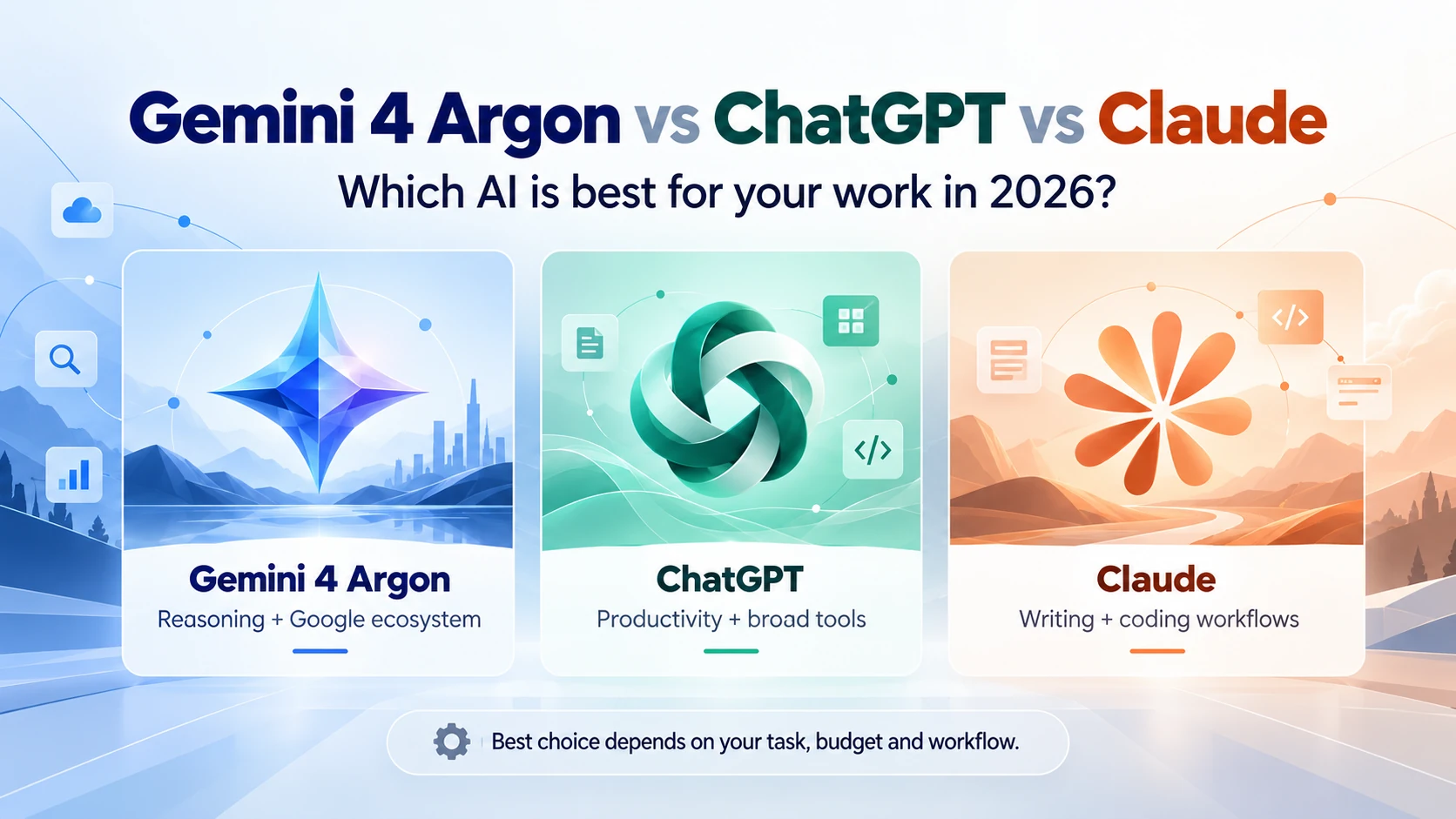
Gemini 4 Argon vs ChatGPT vs Claude: The Quick Verdict
There is no verified winner for every type of user. The best platform is the one that completes your important work correctly and economically.
- Start with Gemini if you work heavily in Google's ecosystem, want the latest Argon reasoning capabilities, or regularly analyse varied text, images, video and documents. Confirm your specific subscription and feature availability.
- Start with ChatGPT if you want a broad productivity environment for research, writing, documents, images, analysis, coding support and connected workflows.
- Start with Claude if you want to evaluate a dedicated coding ecosystem, extended written analysis and long-running agent workflows.
- Do not switch based on one leaderboard. Model configurations and evaluation methods change which system appears strongest.
These are informed starting points drawn from product documentation and independent benchmark results, not the findings of a new hands-on comparison conducted by Khalsa Website Designers.
| Your main task | Sensible starting point | What to check before paying |
|---|---|---|
| General productivity | ChatGPT | Tools included in your plan |
| Google Workspace-heavy work | Gemini | Connected-app access and permissions |
| High-end reasoning | Compare Argon, Astra and Opus | Task-specific benchmark and reasoning setting |
| Coding and repositories | Claude Code, Codex or Antigravity | Test pass rate, code quality and permissions |
| Large documents and PDFs | Gemini or Claude | Evidence extraction and file limits |
| SEO and content strategy | Any of the three | Source accuracy and editing effort |
| Automation for a business | The best-tested workflow | Approval controls and running cost |
| Limited budget | Begin with free access | Limits on the features you need |
Bottom line: if your current AI already solves your tasks well, a new release alone is not a compelling reason to change. Try the alternative on one realistic assignment first.
What Is Google Gemini 4 Argon?
Gemini 4 Argon is Google's frontier reasoning model intended for demanding tasks including programming, scientific reasoning, mathematics, research, professional knowledge work and multi-stage agentic workflows. Google initially restricted access to selected cybersecurity partners, then announced wider public availability on 13 October 2026. Its official launch announcement describes the rollout to developers, enterprises and eligible subscribers.
The model is not a separate replacement for the entire Gemini ecosystem: it is one particular model accessed through supported Google products and services.
Gemini 4 Argon capabilities and limits
| Capability | Official specification |
|---|---|
| Model ID | gemini-4-argon |
| Context window | 1,048,576 tokens |
| Inputs | Text, images, audio, video and PDFs |
| API output | Text |
| Reasoning levels | Low, medium and high |
| Function calling | Supported |
| Grounding with Google Search | Supported |
| Computer use | Preview availability |
| Native image generation by Argon | Not supported |
| Standard synchronous output limit | 65,536 tokens |
| Long decode | Larger outputs via background execution |
Sources: Gemini Argon model details and Google's developer guide.
The long context capacity can help with extensive documents and software-related material. It does not guarantee perfect recall, factual correctness or complete analysis of every paragraph. Information must still be verified against the original source.
Can anyone use Gemini 4 Argon today?
Google says Gemini 4 Argon is available in the Gemini app to Google AI Pro and Ultra subscribers. Developers can access it through the paid Gemini API, subject to account eligibility, quotas and applicable billing. Google AI Ultra subscribers also have access through eligible developer tools. Availability differs across app, API, AI Studio, Antigravity and other products.
Important: Google AI Pro access in the Gemini app does not provide Argon through the API Free tier. The model's developer documentation explicitly distinguishes these arrangements. See Google's Gemini app release and the API guide.
What Is the Difference Between Gemini, ChatGPT and Claude?
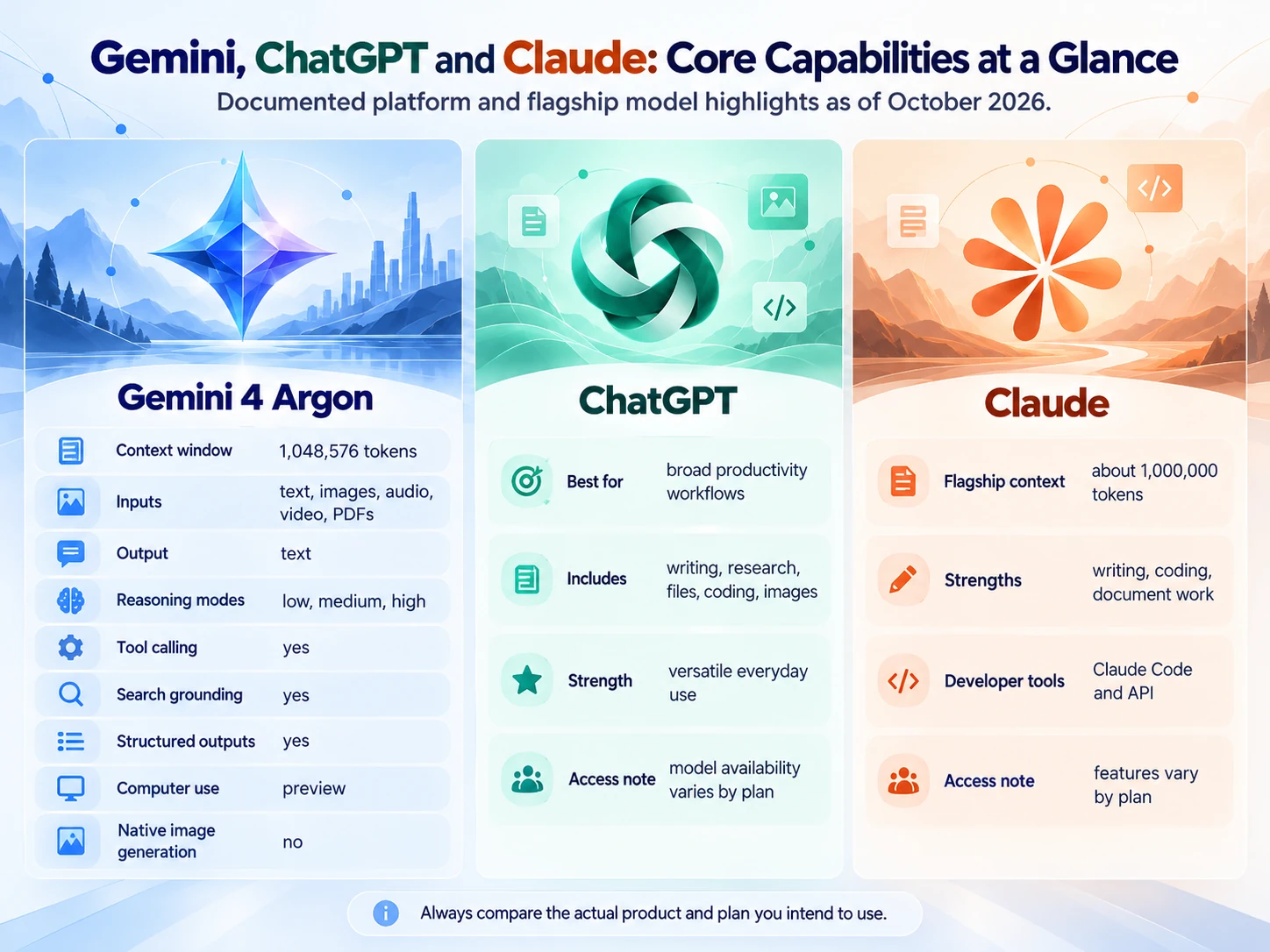
Gemini, ChatGPT and Claude are products or product ecosystems; Gemini 4 Argon, GPT-6 Astra and Claude Opus 5.5 are individual models. Confusing these two levels leads to incorrect comparisons, especially around image creation, file uploads, app connections and subscription access.
Google Gemini: ecosystem and workflow
Gemini includes Google's consumer AI app, selected Google Workspace integrations, Google AI Studio, the Gemini API and development experiences such as Antigravity. For people who work extensively in Gmail, Drive or Docs, integration may be a practical advantage. However, features vary by account, region, product and plan; the complete Gemini app can offer creative tools that the underlying Argon API model does not support directly.
OpenAI ChatGPT: productivity and development
ChatGPT provides conversational assistance, deep research, data and file analysis, image creation, writing and productivity tools. OpenAI also provides Codex for coding and ChatGPT Work for extended computer and app-based tasks. Its current models include GPT-6 variants and GPT-6 Astra, with different access paths and limits. Check the ChatGPT pricing and plan features before assuming that a particular model is available in normal Chat, Work and Codex alike.
Anthropic Claude: analysis and coding
Claude provides a conversational assistant, document and research workflows, Claude Code and developer APIs. Anthropic's Fable, Opus, Sonnet and Haiku models serve different capability and cost requirements. Claude Code can operate in a development workflow, but its success also depends on permissions, available tools, repository quality, execution environment and testing. See the Claude model documentation.
Which Current AI Models Are Actually Being Compared?
Interested in other AI model families? Our LLaMA Maverick vs Qwen3 comparison for Punjabi AI explores a different model-selection question.
Do not compare a flagship API model against a default, lower-cost chatbot configuration and present the result as a fair contest. Identify the exact model and reasoning setting used.
| Provider | Representative model | Why it matters |
|---|---|---|
| Gemini 4 Argon | Frontier long-horizon reasoning | |
| OpenAI | GPT-6 Astra | Highest-end demanding tasks |
| OpenAI | GPT-6.1 Sol | Lower-cost demanding work |
| OpenAI | GPT-6 Luna | Economical high-volume use cases |
| Anthropic | Claude Fable 5.1 | High-end agentic reasoning |
| Anthropic | Claude Opus 5.5 | Coding and knowledge work |
| Anthropic | Claude Sonnet 5.5 | Capability and efficiency balance |
| Anthropic | Claude Haiku 5.5 | Fast, economical model tier |
These are model positions, not a statement that every model is included with every consumer subscription. Consult the OpenAI model catalogue, Google's Argon documentation and Anthropic's model guide for your actual account and workload.
↑ Back to contentsGemini vs ChatGPT vs Claude Pricing: Subscription or API?
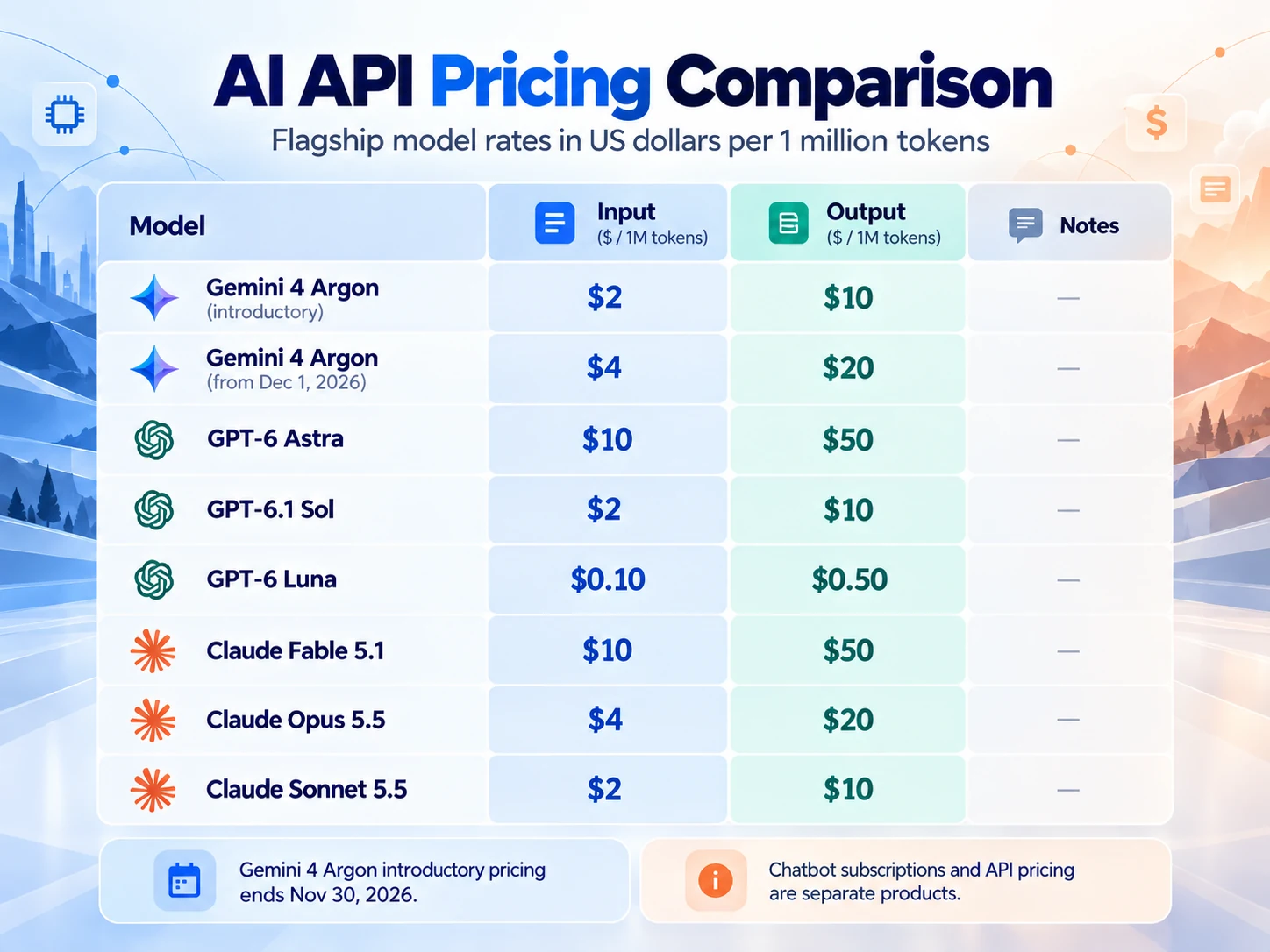
Many comparisons mix monthly chatbot fees with pay-per-token developer pricing. They are different products. A subscription normally pays for access to an interface and included features with limits; an API charges for consumption and may additionally bill for tools, caching and execution services.
Consumer and business subscription costs
Some representative publicly advertised US monthly prices include Google AI Pro at $19.99, ChatGPT Plus at $20, and Claude Pro at $20 on monthly billing (Anthropic also displays an annual-billing discount). All three have free-entry options and more expensive plans. Google AI Ultra, ChatGPT Pro and Claude Max have higher-cost choices and varying allowances.
Rather than promise that a particular advanced model always comes with a specific tier, consult each provider's Google AI subscriptions, ChatGPT pricing and Claude pricing. Prices, taxes, regional offers and usage limits can change; India or other non-US markets may differ.
API pricing for selected models
Standard published US-dollar prices per one million input and output tokens, reviewed 14 October 2026:
| Model | Input per 1M | Output per 1M |
|---|---|---|
| Gemini 4 Argon — through 30 Nov 2026 | $2 | $10 |
| Gemini 4 Argon — from 1 Dec 2026 | $4 | $20 |
| GPT-6 Astra | $10 | $50 |
| GPT-6.1 Sol | $2 | $10 |
| GPT-6 Luna | $0.10 | $0.50 |
| Claude Fable 5.1 | $10 | $50 |
| Claude Opus 5.5 | $4 | $20 |
| Claude Sonnet 5.5 | $2 | $10 |
Sources: Gemini API pricing, OpenAI API pricing, Anthropic API pricing. Rates shown are base token prices, not all-in project expenses. Other tiers, longer contexts, caching modes or tools may change charges.
Gemini Argon's scheduled December price increase
Google lists Argon's introductory API rates of $2 input and $10 output per million tokens through 30 November 2026, changing to $4 input and $20 output from 1 December 2026. An application deployed in November should be budgeted against the price it will face in December. Confirm the change on the official Argon developer page.
Which is actually the cheapest AI?
Token rates alone do not answer that question. A low-priced model that requires five retries, extensive checking and manual repair may cost more than a higher-priced model that succeeds once. Measure cost per completed, verified task including tool fees, retries and human correction. When buying a subscription, compare the features you really use, usage limits and how frequently you are blocked—not the maximum possible number of features.
Independent Benchmarks: Which Model Performs Best?
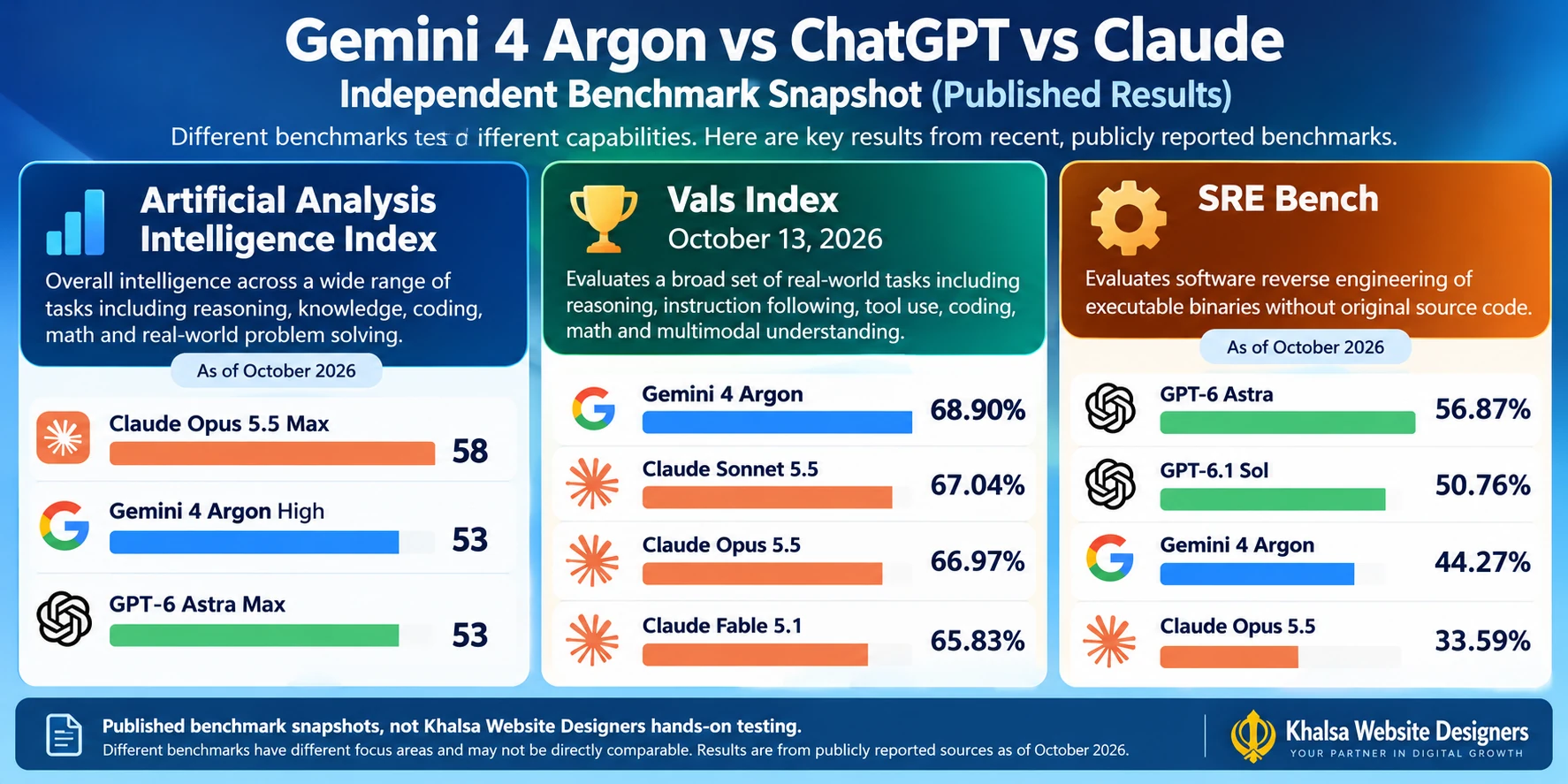
Benchmark winner is not the same as best chatbot. Assess which task is measured, model settings, evaluation date, support tools and scoring method. Several reputable benchmarks produce different leaders.
Artificial Analysis Intelligence Index
The Artificial Analysis direct comparison lists Gemini 4 Argon High at 53 and Claude Opus 5.5 Max at 58 on its Intelligence Index. Other publicly reported scores place GPT-6 Astra Max at 53 in the comparable high-end model group. Scores are tied to those specific reasoning configurations.
| Test | Gemini Argon High | Claude Opus 5.5 Max |
|---|---|---|
| Intelligence Index | 53 | 58 |
| AutomationBench-AA | 78% | 70% |
| Terminal-Bench 4.0 | 57% | 60% |
| SciCode | 62% | 67% |
| Humanity's Last Exam | 57% | 61% |
| AA-LCR v1.1 | 80% | 85% |
Argon leads the listed automation test while Opus leads several other tests. A different reasoning setting may produce different results; these are not percentages of performance for a consumer plan.
Vals Index: Gemini Argon leads this evaluation
The independent Vals Index, updated 13 October 2026, weights agentic tasks across sectors including finance, coding, legal and tax work. Its published results are 68.90% for Gemini 4 Argon, 67.04% for Claude Sonnet 5.5, and 66.97% for Claude Opus 5.5. Google highlights this first-place result in its launch announcement. It is a meaningful result for that particular test—not proof of an all-purpose winner.
SRE Bench: GPT-6 Astra leads a specialised test
The Vals SRE Bench, also updated 13 October 2026, tests whether AI agents can determine what software binaries do without original source code. It reports 56.87% for GPT-6 Astra, 50.76% for GPT-6.1 Sol, 44.27% for Gemini 4 Argon, and 33.59% for Claude Opus 5.5. This specialised result should not be repurposed as a ranking for ordinary websites, writing quality or general customer support.
How to interpret apparently conflicting results
They need not conflict. One benchmark rewards broad economic agentic performance, another aggregates reasoning and knowledge tasks, while another measures binary investigation. Model thinking effort, tool access, prompts and time budgets can also differ. A credible comparison reports the benchmark name, exact model version, setting, date and limitation rather than declaring a universal champion.
Which AI Is Best for Complex Reasoning and Research?
Research and reasoning involve finding evidence, reading it accurately, noticing gaps, testing interpretations and explaining conclusions. A model can perform well on mathematics yet misunderstand a contract; another may write a polished report that cites the wrong source.
Gemini Argon is worth evaluating for long-context, multimodal and complex multi-stage problems. GPT-6 Astra is a competing high-capability option in OpenAI's ecosystem. Claude Opus 5.5 is another serious candidate for knowledge work and agents. There is no basis to claim any one of these will win every research assignment.
For an important research task, require the assistant to identify the source supporting each major claim, distinguish fact from inference, and state which questions remain unanswered. Open links and verify the evidence independently. Do not confuse confident phrasing with accuracy.
Speed, Context Windows and Long Documents
Published API context windows for Gemini 4 Argon, GPT-6 Astra and Claude Opus 5.5 are around one million tokens. However, context-window capacity is not a promise that a chatbot subscription accepts a million tokens in every conversation. Product upload limits, supported formats, timeouts and processing settings may differ.
Gemini Argon accepts text, images, audio, video and PDFs and produces text through the model API. Comparable platforms offer different multimodal interfaces and connected document tools. The correct choice depends on the material and how reliably the system extracts and references its contents.
A larger context window does not guarantee that every detail in a long report will be recalled. For extensive PDFs or repositories, ask for an inventory of files and key sections, confirm quotations against originals, and process especially important passages in smaller chunks when useful.
Which AI is fastest? That depends on task length, reasoning setting, model tier, server conditions and tools. Measure time until the useful, correct result is finished—not just how quickly the first sentence appears.
↑ Back to contentsBest AI for Coding and Software Development
Claude Code, OpenAI Codex and Google's Antigravity are serious development options. Each combines model capabilities with tools and execution environments, and each can make mistakes.
Gemini Argon for developers
Google positions Argon for long-horizon coding work, migrations, code reasoning and complex engineering tasks. Its long context and agentic support may be useful for substantial projects. Developers should still validate changes with tests, reviews and platform documentation, and account for API costs and permissions.
ChatGPT, Codex and GPT-6
Codex can help inspect code, propose edits and operate within available development environments. GPT-6 Astra serves higher-end tasks; lower-priced models may be more economical for routine work. The exact capabilities depend on the model, Codex plan and tool configuration. A cheaper result is only an advantage if the code works.
Claude Code and Claude models
Claude Code can support repository workflows and iterative coding tasks. Anthropic positions Opus for long-running agentic coding and Sonnet as a performance-and-cost balance. Do not treat fluent code explanations as evidence of security, correctness or compatibility.
A fair coding comparison checklist
Before selecting a coding assistant, ask it to perform the same well-defined task and check:
- Does the implementation pass appropriate automated tests?
- Does it preserve existing functionality and meet every requirement?
- Are permissions, input handling and secret management appropriate?
- Is the code maintainable and compatible with the project?
- How many retries and human corrections were required?
- What was the total cost and time for the verified outcome?
A system that produces attractive-looking but broken code is not the better coding assistant.
Best AI for WordPress and WooCommerce Websites
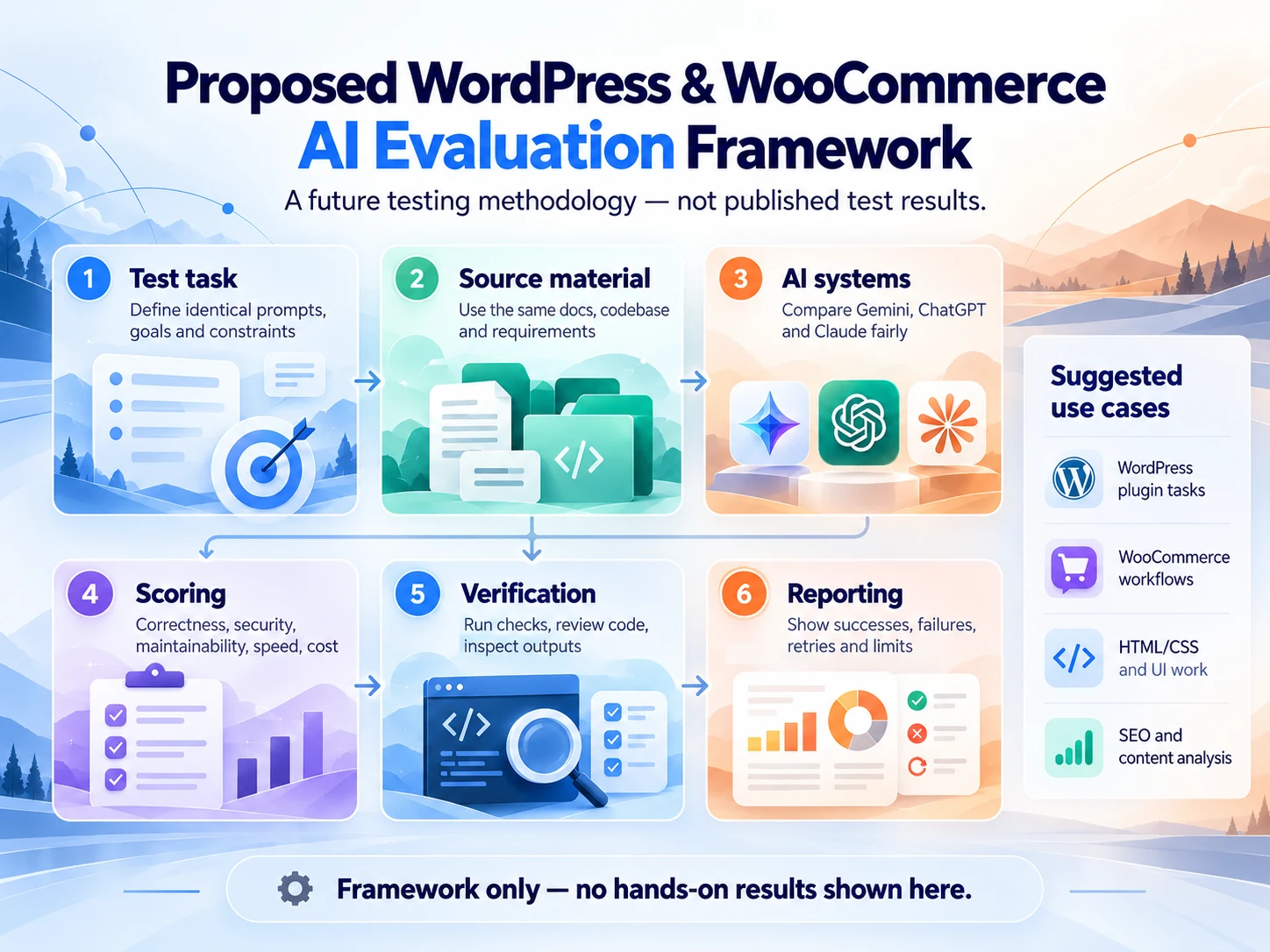
For the wider business implications, see our guide to the future of web design. Our evaluation framework above describes proposed testing, not completed experiments.
At Khalsa Website Designers, our practical professional work includes WordPress, WooCommerce, business website development, performance, security-conscious implementation and SEO. From a website-development perspective, the right test is whether AI-generated changes work safely in the actual project.
WordPress plugins and PHP
AI can help explain hooks, draft PHP functions, analyse performance and review plugin code. But WordPress code should follow the actual platform APIs and use appropriate capability checks, nonces where relevant, sanitisation, validation and escaping. Review changes against the WordPress Developer Resources, run tests and preserve backups. AI-generated code must not be pushed straight to production on the strength of its explanation.
WooCommerce stores
Ecommerce changes can affect payments, orders, inventory, tax handling and customer information. Verify hooks, supported APIs, order-storage compatibility and the behaviour of other extensions. Use a staging store and review WooCommerce developer documentation before deployment. An AI-generated shortcut is not worth corrupting a live checkout or order workflow.
Responsive layout, accessibility and performance
All three ecosystems can help with HTML, CSS, JavaScript and interface ideas. Judge the result in the browser: mobile and desktop layout, keyboard use, readable text, loading behaviour, contrast and accessibility matter more than whether code was produced quickly. Review the implementation against the current design system instead of accepting an attractive generic replacement.
Our practical recommendation for website developers
Test one tool on a safe, read-only audit of an existing plugin or design component. Require a change plan, citations to relevant APIs, rollback steps and specific tests. Only proceed to staging edits after reviewing those findings. There is no newly conducted three-way WordPress benchmark behind this recommendation; it is a professional workflow standard rather than a model ranking.
Best AI for SEO, Content Writing and Digital Marketing
For the underlying writing process, see our content research and writing service. To check your own website's crawlability and technical basics, use our free website audit tool—a different task from comparing AI assistants.
For practical implementation beyond chatbot recommendations, explore our SEO guide and digital marketing advice for small businesses.
All three can support SEO research, keyword grouping, content planning, copy editing, schema explanations and analysis. None should be used to invent search volumes, guarantee rankings or publish business claims that have not been confirmed.
Keyword research and search intent
Use AI to organise possible user questions and identify gaps in a page, but use genuine search data from Google Search Console, Google Keyword Planner or appropriate SEO research platforms when citing volume, competition or ranking positions. Newly released topics may not yet have reliable historical volume estimates.
Content quality and human editing
An AI-generated article becomes useful when it answers real questions with correct facts, original insight and clear language. ChatGPT, Gemini and Claude can all contribute to drafting, restructuring and editing. The final quality depends on input material, the writer's domain knowledge and editorial review. Avoid repeating the same keyword simply to make a page appear optimised.
SEO, AEO and visibility in AI answers
Google says the usual Search foundations remain relevant to AI Overviews and AI Mode. There is no additional special schema that guarantees AI inclusion. Publish crawlable, helpful material, explain who produced it, make important facts accessible in text and keep documentation current. See Google's AI features guidance and people-first content guidance.
Best choice for marketers
Evaluate which assistant helps your team interpret actual data and produce accurate content in the right tone with the least correction. The tool should reduce repetitive work without erasing your company's real services, limits and perspective.
Best AI for Business Owners, Teams and Freelancers
Most business users need reliable outputs more than frontier benchmark leadership. Common tasks include client emails, proposals, summaries, presentations, spreadsheets, meeting preparation and process documentation.
ChatGPT is a practical general-purpose starting point. Gemini can fit teams already working within Google products. Claude is worth considering for writing, document analysis and code-oriented operations. Before purchasing premium tiers, estimate how many hours the tool saves on work you actually perform.
AI-generated quotations and contracts need special attention: confirm real prices, deliverables, timelines, exclusions and legal terms. Do not let an assistant invent guarantees or service commitments.
For connected AI agents, limit permissions and require approval before deleting records, sending messages externally, moving money or modifying production systems. The goal is an authorised, reliable process, not maximum autonomy.
↑ Back to contentsBest AI for Students, Images, Video and Creative Tasks
Students can use free or paid AI systems to explain concepts, practise questions, critique reasoning and review written work. They should verify factual answers and comply with their institution's rules on AI assistance and attribution.
For creative work, compare the actual consumer tools rather than the API model names. Gemini 4 Argon itself does not natively generate images, even though Google's wider AI ecosystem offers image and video creation products. ChatGPT offers image-generation and editing tools through supported experiences; Claude focuses on its own creative and document-oriented capabilities. Product features vary by plan and change frequently.
When creating website visuals, consider commercial-use rights, authenticity, accurate representation of people and products, readable content and accessibility. A generated image should not be presented as a photograph of work that was never performed.
Which AI Is More Accurate and Hallucinates Less?
No single published score establishes the most accurate platform for every domain. A system can fail by inventing a fact, citing an irrelevant source, omitting a requirement or making an unjustified assumption. All three systems require verification in consequential use cases.
For research, check primary sources. For coding, run tests. For numbers, verify calculations. For client websites, confirm business claims against approved information. For legal, medical and financial decisions, involve qualified professionals and the appropriate official documentation. A citation only helps if it genuinely supports the statement beside it.
Useful rule: treat the AI answer as a draft analysis until the important claims have been checked.
AI Privacy, Data Training and Business Security
AI privacy also involves crawler controls. See our explanation of Cloudflare AI Labyrinth for the separate issue of how unwanted AI crawlers interact with websites.
Privacy obligations differ between consumer chats, team or enterprise subscriptions and API products. Review the terms for the exact service you use rather than assuming every product from one company has the same rules.
OpenAI documents how ChatGPT content may be used and distinguishes eligible consumer controls from business and API data handling. Anthropic publishes consumer training guidance and commercial product guidance. Google provides Gemini Apps privacy information, while enterprise and developer services have their own terms.
Before connecting a customer database or website administration account, review retention, access permissions, logging, authorised data use and organisational obligations. Do not paste passwords, API keys, confidential payment information or unnecessary personal data into prompts. Use staging, backups and approval controls for website changes.
Biggest Strengths and Limitations of Each Platform
Gemini: strengths and trade-offs
Strengths: Google's ecosystem, multimodal input handling, long-context capability and strong Argon results on selected agentic benchmarks. Trade-offs: complex product access rules, feature differences between consumer and developer services, varying task performance and an upcoming Argon API price increase.
ChatGPT: strengths and trade-offs
Strengths: wide productivity feature set, research and document tools, image tools, coding support and integrated work options. Trade-offs: different access across ChatGPT, Work and Codex, plan-based limits, and higher developer pricing for GPT-6 Astra compared with more economical models.
Claude: strengths and trade-offs
Strengths: professional text and code workflows, Claude Code, long-context models and strong independent scores for Opus 5.5 in selected evaluations. Trade-offs: subscription usage limits, model-related costs, feature differences by plan and variable performance across tasks.
↑ Back to contentsShould You Switch to Gemini Argon, ChatGPT or Claude?
A switch makes sense when another tool consistently solves a real problem: inaccurate outputs, missing integrations, unaffordable usage, poor code quality or disruptive limits. Changing platforms because a company announced a benchmark win may not improve your actual work.
Before cancelling, run the same representative task on both systems, inspect the result independently and account for your stored projects, connected apps, renewal dates and onboarding costs. If your existing platform works reliably, consider keeping it and testing alternatives on a limited basis rather than paying for overlapping premium plans.
Can you use all three together?
Yes. One AI might assist research, another help with development and a third review omissions. That can be useful, but agreement among multiple models is not independent factual verification. The models can share similar errors. Add tools only when they provide a practical, measurable benefit.
How This Article Was Researched—and What Was Not Tested
Our editorial standards explain our approach to source verification, corrections, AI assistance and avoiding invented first-hand claims. The published benchmarks here belong to their respective testing organisations.
This comparison is based on public information reviewed on 14 October 2026: official model specifications, provider pricing and release notes, independently published model evaluations, and relevant WordPress and search documentation. The cited scores belong to their respective benchmark organisations and model configurations.
Khalsa Website Designers has not performed a new, controlled head-to-head experiment running identical tasks through Gemini Argon, ChatGPT and Claude for this article. The website-development recommendations reflect professional implementation principles rather than unpublished comparative test results.
A fair future test would disclose the full prompts, models, reasoning settings, tool permissions, test environment, outputs, failures, retries, verification steps, human intervention, timestamps and cost. Without that material, claims of first-hand superiority would be misleading.
Frequently Asked Questions
Is Gemini 4 Argon better than ChatGPT?
Not for every use. Argon leads selected independent benchmarks, but ChatGPT's complete product offers a different set of tools and integrations. Compare the actual task, plan and model settings.
Is Gemini 4 Argon better than Claude Opus 5.5?
It depends on the benchmark. Argon leads the Vals Index and selected automation tests; Opus 5.5 Max leads on the compared Artificial Analysis Intelligence Index. Neither is a universal winner.
Is Gemini Argon free?
The Argon API is not available through the Free tier. Eligible Google AI Pro and Ultra subscribers can access Argon through the Gemini app. Google's free Gemini experience offers other features and models.
How do I access Gemini 4 Argon?
Check the Gemini app under an eligible Pro or Ultra subscription, or use the paid Gemini API for developer applications. Product availability and usage limits depend on account and region.
Does Google AI Pro include Argon API access?
No, not merely because the plan includes Argon in the Gemini app. Google documents separate paid access requirements for the API. Check its developer guidance.
Is GPT-6 Astra included with ChatGPT Plus?
Astra access depends on the OpenAI product and workflow. ChatGPT Work, Codex and ordinary Chat can have different access and limits. Verify the current plan matrix and model picker rather than assuming the API and chatbot offer identical access.
What is the difference between GPT-6 Astra and GPT-6.1 Sol?
Astra is a higher-cost flagship option, while GPT-6.1 Sol offers strong performance at a lower API token rate. Choose by results and total task cost, not model name alone.
Which AI is best for programming?
Claude Code, Codex and Google development tools all deserve evaluation. Use tests and real project constraints to make the decision; no single benchmark covers every codebase or language.
Which is best for WordPress and WooCommerce?
No verified three-way WordPress benchmark establishes an overall winner here. Inspect generated code for correct APIs, permission handling, security, compatibility and maintainability, and test in staging.
Which AI is best for SEO and blog writing?
All three can assist. Use genuine keyword data, verified business information, source checks and human editing. AI cannot promise a number-one Google ranking.
Can Gemini 4 Argon generate images?
Not natively through the Argon model API. Other products within Google's broader ecosystem offer image creation. Compare those creative features separately.
Which AI can analyse the biggest PDFs?
Flagship API models from all three vendors provide very large context capacities, but actual upload limits and analytical reliability differ. Verify extracted details against the source files.
Which AI hallucinates the least?
There is no universal winner across all tasks. Verify consequential answers using reliable primary sources and appropriate tests.
Which AI is best for confidential company information?
That depends on the exact consumer, enterprise or API product and its contract, privacy controls and retention rules. Select a service that meets your organisation's obligations.
Is Claude better than ChatGPT for writing?
Writing preference depends on the reader, style, subject and instructions. Compare actual drafts and editing required; fluency alone does not prove factual quality.
Is Gemini Argon's introductory API price permanent?
No. Google's published price schedule changes from 1 December 2026. Budget for the scheduled standard price.
Which AI is cheapest for developers?
The cheapest token price is not always the lowest cost for a finished task. Include retries, tool charges, verification and corrections.
Is it worth buying all three AI subscriptions?
For many users, no. Start with one that handles your essential work and add another only when there is a clear productivity advantage.
Which AI is best for students?
Free plans can cover many learning needs. Use AI for explanations and practice, check accuracy, and follow academic integrity rules.
Can I use Gemini, ChatGPT and Claude in one workflow?
Yes, but preserve clear roles and access permissions. Multiple agreeing answers do not automatically prove correctness.
Does using AI content hurt SEO?
Google's guidance focuses on helpful, people-first content rather than treating all AI assistance as automatically harmful. Fabricated claims, mass-produced filler and ranking manipulation are poor practices regardless of the writing tool.
Should I cancel ChatGPT or Claude for Gemini Argon immediately?
Not solely because Argon launched. Test a representative task, review the total cost and switching friction, and keep what reliably works.
Final Recommendation: Which AI Should You Choose in 2026?
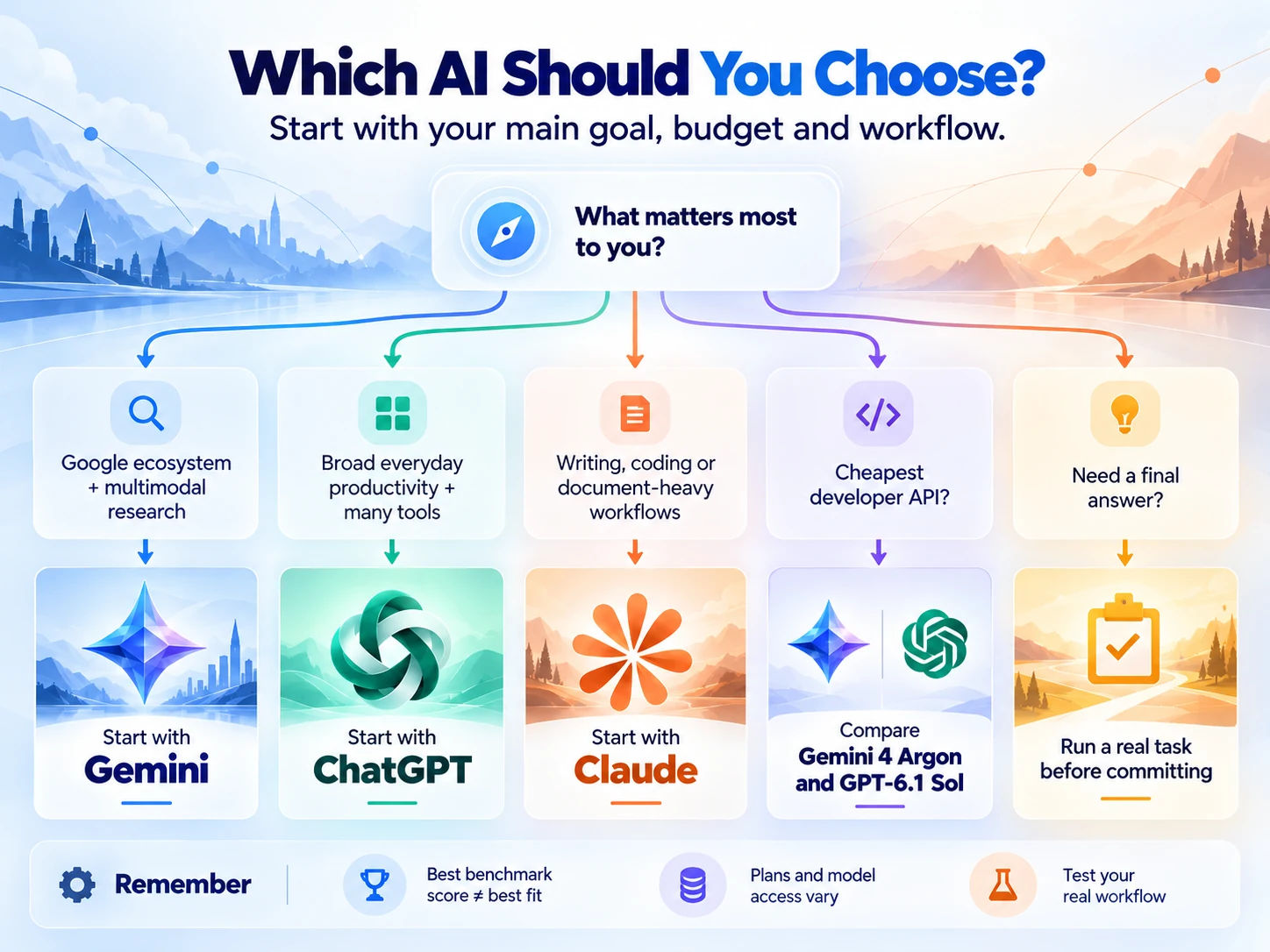
Google Gemini 4 Argon is worth evaluating, especially for users interested in long-context multimodal reasoning, Google's ecosystem and the results shown on selected agentic benchmarks. Its API introductory price is attractive, but temporary.
ChatGPT remains a broad productivity option for people who move among writing, research, document tasks, analysis, images and software work. Claude remains a strong alternative for developer-oriented and knowledge-intensive workflows, with competitive independent results in selected configurations.
Choose based on the reliability of the work you need completed, not the excitement around a release. Compare a realistic task, verify the finished result, check the plan restrictions and pay for what provides measurable value.
For web developers and business owners, AI should strengthen professional judgement rather than replace technical testing, privacy precautions and accurate client information.
↑ Back to contentsOfficial Sources and Further Reading
- Google: Gemini 4 Argon public launch
- Google: Gemini 4 Argon technical specifications
- Google: Gemini API pricing and changes
- OpenAI: ChatGPT consumer pricing and model access
- OpenAI: API pricing and model catalogue
- Anthropic: Claude subscriptions
- Anthropic: Claude API pricing
- Artificial Analysis: Argon vs Opus independent comparison
- Vals AI: Vals Index
- Vals AI: SRE Bench
- Google Search Central: AI features and your website
- WordPress Developer Resources
Editorial disclosure: This page contains documented, evidence-informed recommendations, not paid model rankings or an unpublished head-to-head experiment. Prices, model availability and benchmark scores may change. Information reviewed on 14 October 2026; Argon's scheduled 1 December 2026 pricing change requires a follow-up check.
